Choose a thermoformer if…
you produce high, steady volumes of a few formats, want to avoid tray stock and have room for a line with compressed air and cooling.

Both close food packs with film and heat, and both can work under vacuum or modified atmosphere. The difference is the pack: a thermoformer makes it in line from rollstock; a tray sealer seals trays that arrive ready-made.
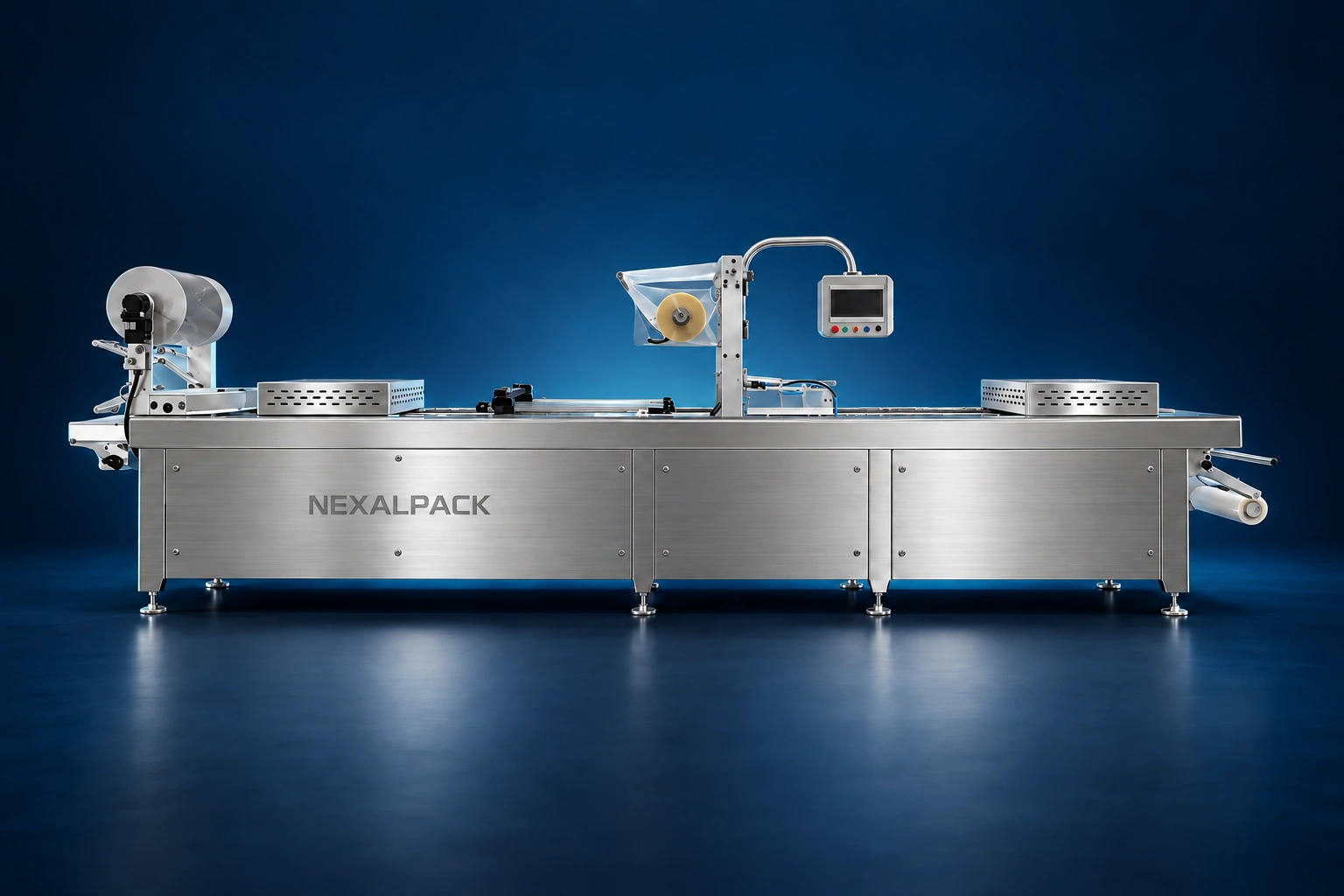
| Thermoformer | Tray sealer | |
|---|---|---|
| Pack | Formed in line from a roll of film | Preformed tray |
| Packaging formats | Vacuum, vacuum + gas (MAP); skin with rigid film on some models | Seal only, gas flush, MAP and skin (VSP), depending on the model |
| Reference output | 4–6 cycles/min; up to 12 under vacuum (NEX-420A-U) | From 450 trays/hour on manual units to automatic lines |
| Space | Lines about 3 to 6 m long | From 38 cm tabletop units to lines of about 3 m |
| Format change | Change of mould and forming tooling | Change of tray mould |
| Consumables | Two rolls of film (bottom and top) | Preformed trays and a roll of lidding film |
Reference data from NEXALPACK specification sheets; each project is confirmed in the quotation.
you produce high, steady volumes of a few formats, want to avoid tray stock and have room for a line with compressed air and cooling.
your product is sold in a rigid tray, you change format often, you are starting with small runs or you need a MAP or skin presentation in a tray.
start from the pack your customer wants. The pack decides the technology; then the hourly output decides the model.
It depends on the model and configuration: a manual tray sealer is far smaller and simpler than a thermoforming line. In production, pack cost also counts: preformed trays versus film on a roll. We work it out in the quotation.
Yes. Thermoformers do vacuum + gas flush, and tray sealers configured for MAP evacuate, inject gas and seal.
Skin tray sealers (tabletop, semi-automatic, rotary or automatic with VSP) are the most direct option. In thermoforming, some models accept skin with rigid film.
Leave your enquiry and we will follow up on WhatsApp.
Hello! 👋 Tell us what product you want to pack. Complete these three steps and send us your enquiry: the sales team receives it straight away and you can carry on the conversation on WhatsApp.