1. Loading the tray
The product is placed in a preformed tray, which goes into the sealing mould: by hand on manual and semi-automatic machines, or by conveyor on automatic ones.

Tray sealing closes a pack with heat and pressure: a lidding film is welded to the rim of a preformed tray. It is the basis of tray packaging for meat, fish, ready meals, cheese and cut fruit.
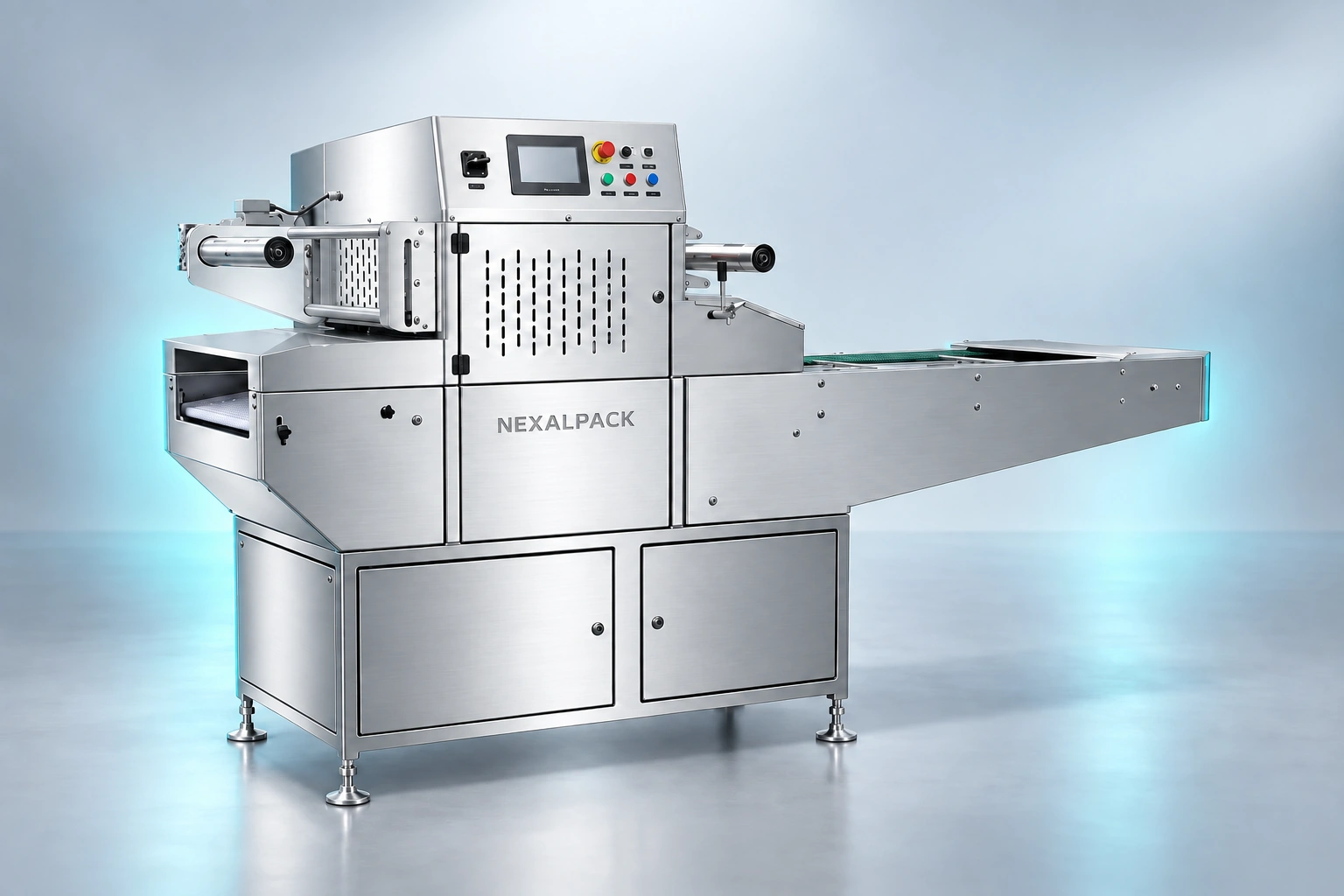
The product is placed in a preformed tray, which goes into the sealing mould: by hand on manual and semi-automatic machines, or by conveyor on automatic ones.
If the product needs it, the chamber closes and a vacuum is drawn, gas is injected (MAP) or skin film is applied. If not, the tray is sealed in air.
A heated plate presses the film onto the tray rim for a set time and at a set temperature. The film is then cut to the outline and the waste is rewound.
Tray and film are chosen together: the film has to seal onto the tray material. Plastic, aluminium and fibre trays are used, plain or compartmented, with clear, peelable or high-barrier films depending on the product and the planned storage.
Three settings govern seal quality: temperature, time and pressure. A rim free of product, fat or liquid matters as much as the machine settings. Our manual tray sealers adjust temperature from 0 to 240 °C.
A new tray format means a new mould, so it pays to decide early which trays you will use.
| Type | How it works | Reference output | Models |
|---|---|---|---|
| Manual | The operator places the tray and lowers the head | 450 trays/hour | NEX-175, 175D, 225, 225D ↗ |
| Tabletop | Manual loading with gas flush, MAP or skin | 2–6 cycles/min | NEX-271, 272, 273 ↗ |
| Semi-automatic | The operator loads; the machine evacuates, flushes, seals and cuts | Seal only: 7–8 cycles/min | NEX-450M/2 ↗, NEX-550M ↗ |
| Rotary | Alternating loading and sealing on a rotating platform | Seal only: 7–8 cycles/min | NEX-370R ↗, NEX-450R ↗ |
| Automatic | Trays fed by conveyor, in line | Seal only: 8–10 cycles/min (NEX-450A) | NEX-450A ↗ and others |
One cycle can seal several trays depending on the mould. Figures are indicative and are confirmed in the quotation.
Closing a pack with heat and pressure, usually a film sealed onto the rim of a preformed tray.
In tray sealing the tray arrives preformed and the machine only closes it. In thermoforming the machine makes the pack in line from a roll of film. We explain it in the thermoformer vs tray sealer guide.
The top film sealed onto the tray. It can be clear, peelable (easy-open) or high-barrier, and must be compatible with the tray material.
Yes. Tray sealers configured for MAP draw a vacuum and inject gas before sealing; some also run vacuum skin.
Leave your enquiry and we will follow up on WhatsApp.
Hello! 👋 Tell us what product you want to pack. Complete these three steps and send us your enquiry: the sales team receives it straight away and you can carry on the conversation on WhatsApp.