1. Forming
The bottom web runs from the roll, is heated and formed in the mould by vacuum or compressed air. On our thermoformers, forming depth reaches 120 mm.

In thermoformed packaging, the machine makes the pack in the line itself: it heats film from a roll, forms it in a mould, the product is loaded and a second film closes the pack. This is the process of thermoforming packaging machines, also known as horizontal form-fill-seal.
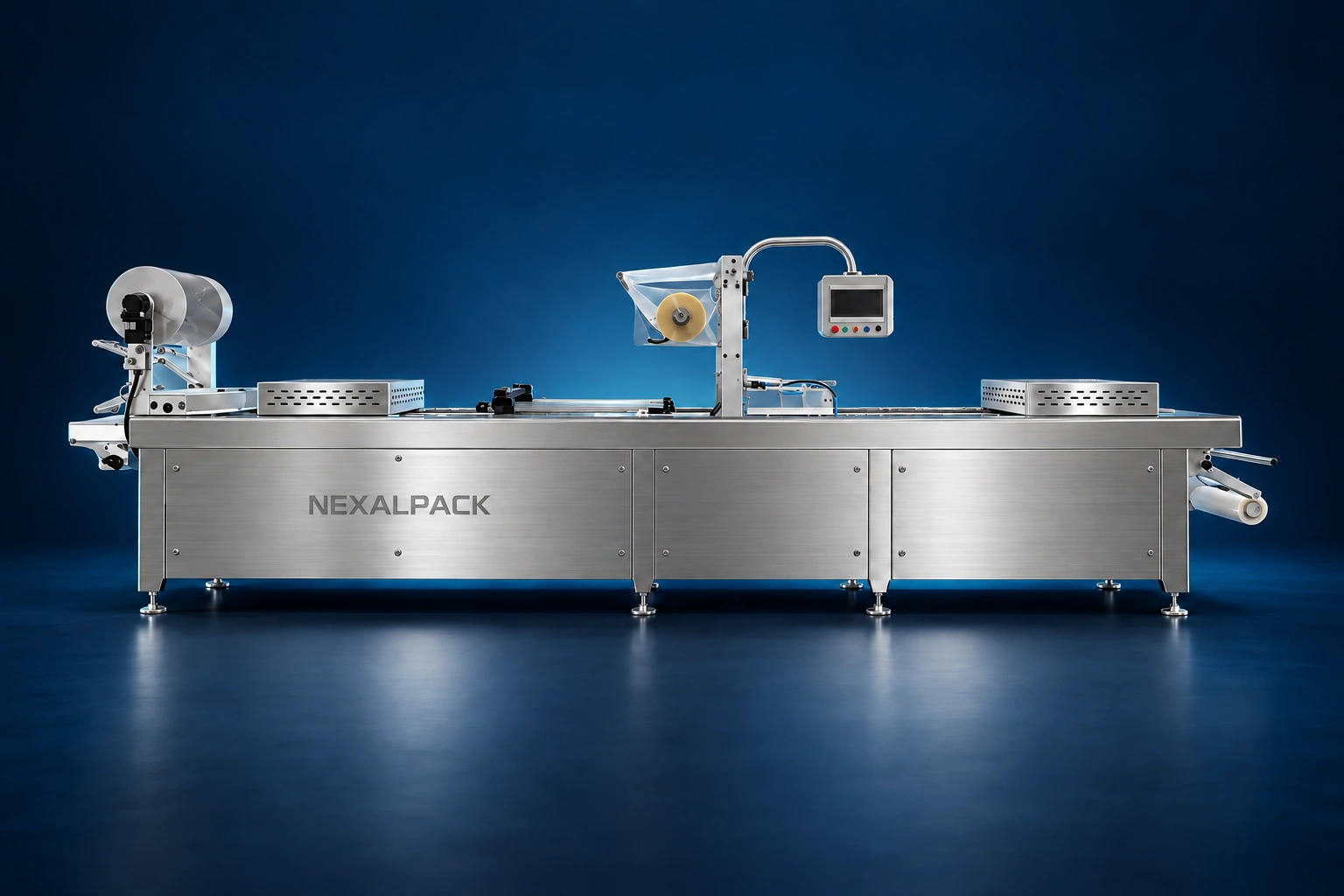
The bottom web runs from the roll, is heated and formed in the mould by vacuum or compressed air. On our thermoformers, forming depth reaches 120 mm.
The cavities move to the loading zone, where the product is placed by hand or by an automatic feeder.
At the sealing station a vacuum is drawn, gas is injected if needed and the top film is heat-sealed.
Cross and longitudinal cutters separate the packs, which leave on the discharge conveyor.
The bottom web width sets the machine size: 322 mm on the NEX-320A, 422 mm on the NEX-420A and 522 mm on the NEX-520A.
The pack is made in line from rollstock: you do not buy or store preformed trays.
Designed for repetitive formats and steady output: 4–6 cycles/min on standard models and up to 12 cycles/min under vacuum on the NEX-420A-U.
The mould defines the shape and the number of cavities per cycle. Changing format means changing the tooling.
A pack whose shape is created by heating a plastic film and moulding it. In food packaging it is formed, filled and sealed on the same machine.
According to our sheets: three-phase 380 V power, compressed air (0.5 to 0.8 MPa) and water cooling on most models. Space too: lines range from about 3 m (NEX-320A(Q)) to 6 m long.
Thermoforming suits high volumes and stable formats; tray sealing suits preformed trays, more format flexibility and outputs from very small. We compare them in the thermoformer vs tray sealer guide.
Leave your enquiry and we will follow up on WhatsApp.
Hello! 👋 Tell us what product you want to pack. Complete these three steps and send us your enquiry: the sales team receives it straight away and you can carry on the conversation on WhatsApp.