
How much does a tray sealer cost, and what drives the price?
In Spanish catering-equipment shops, a tray sealer for catering trays costs between about €900 and €2,700 excluding VAT, and a tabletop unit with vacuum and gas flush between €5,300 and €6,800 (prices published in November 2026). Industrial tray sealers have no list price: they are quoted on process, output, moulds and installation.
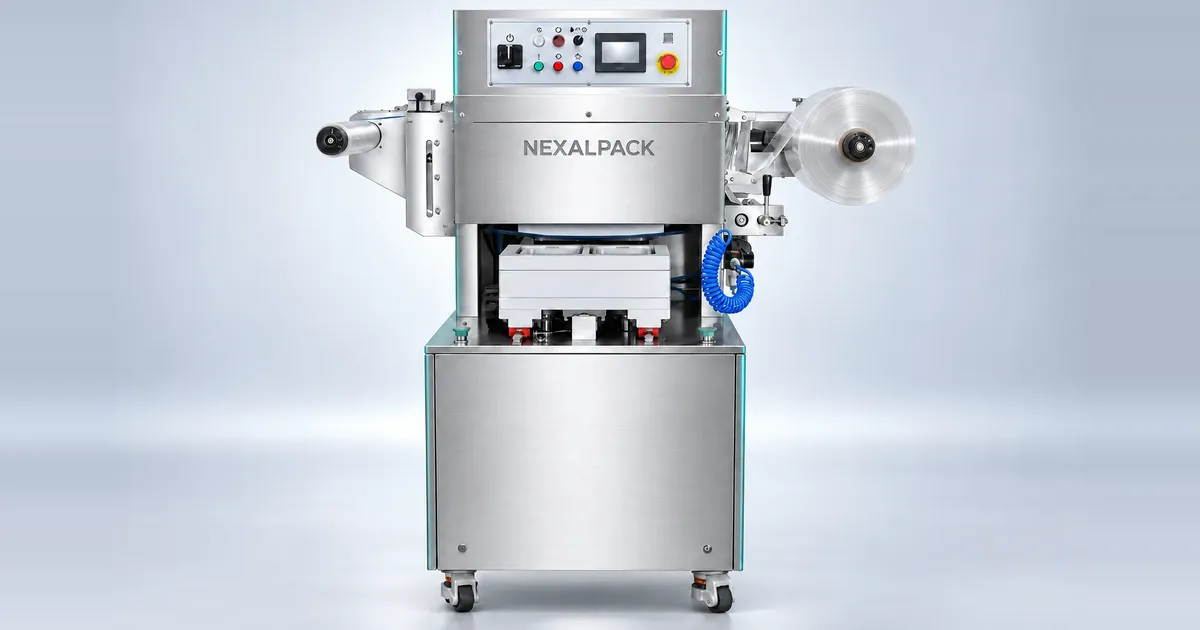
Tray sealing machine prices in Spain (2026)
Published prices range from about €900 for a catering tray sealer to around €6,800 for a tabletop unit with vacuum and gas; above that, the price depends on the project.
| Type of tray sealer | Published price (excl. VAT) | What it does |
|---|---|---|
| Catering tray sealer, manual or semi-automatic | €880 – €2,682 | Seals preformed trays with film, without gas. Each tray format uses its own mould. |
| Tabletop unit with vacuum and gas flush | €5,279 – €6,799 | Draws a vacuum, flushes protective gas and seals: modified atmosphere packaging (MAP). |
| Extra mould for another tray format | €97 – €259 | Each tray size or shape needs its own mould. |
| Industrial: semi-automatic, rotary or automatic in-line | On quotation | Configured for a specific product, format and output. |
Prices of 13 products (9 tray sealers and 4 moulds) published by a Spanish online shop for catering equipment, checked on 16 November 2026. Prices excluding VAT; some are offer prices. Bag sealers are not included. These are other brands’ prices, not Nexalpack prices.
These machines are designed for restaurants, kitchens and shops: they seal a few trays per cycle and the operator loads each tray. For continuous production, or for modified atmosphere or skin packaging on an industrial scale, you move to a semi-automatic, rotary or automatic tray sealer, and from there the price is no longer a catalogue price.
You can compare the manual and tabletop models in manual and tabletop tray sealers and the full range in industrial tray sealing machines.
What drives the price of an industrial tray sealer
The price of an industrial tray sealer is set mainly by the packaging process, the output you need, the moulds and what the installation requires.
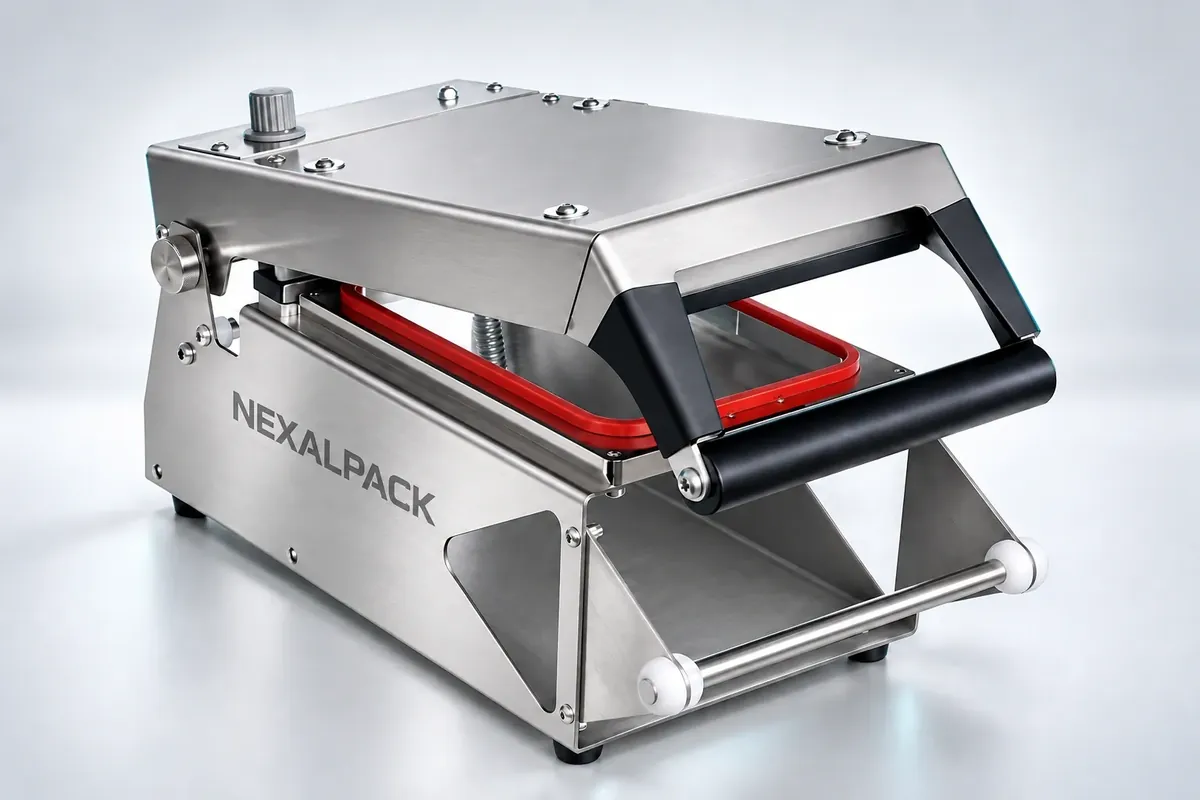
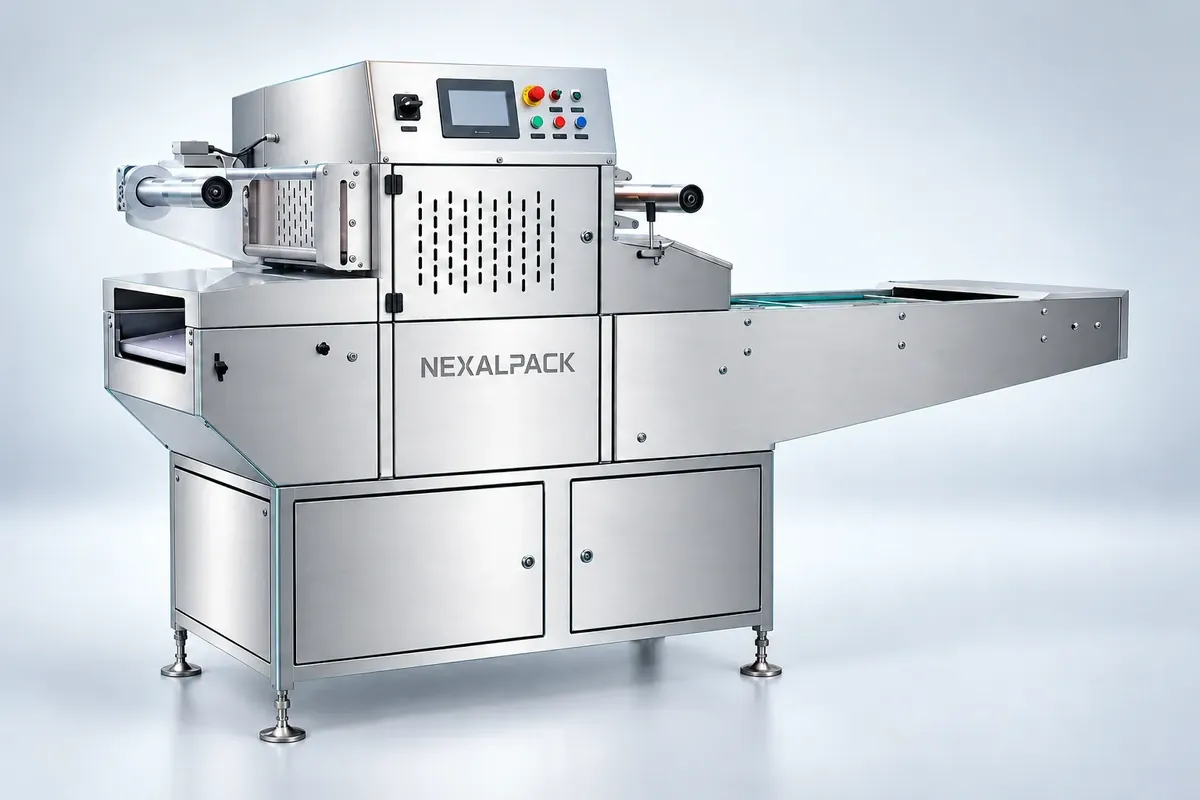
| Factor | Why it changes the price | Example in the Nexalpack range |
|---|---|---|
| Level of automation | On a manual machine the operator places the tray and starts the seal; on an automatic one the trays arrive on a conveyor and leave sealed, continuously. | From the manual NEX-175 and NEX-225 (450 trays/hour) to the automatic NEX-450A, NEX-550A and NEX-650A. |
| Process: seal, gas, MAP or skin | Gas flushing, drawing a vacuum or applying skin film adds a sealed chamber, valves and, for MAP and skin, a vacuum pump. | The NEX-271 flushes gas without a pump; the NEX-272 (MAP) and the NEX-273 (MAP and skin) have a 20 m³/h pump. |
| Vacuum pump | More capacity allows faster MAP or skin cycles, but the pump is bigger and more expensive. | From 10 m³/h on the NEX-240TS to 63 m³/h on the NEX-450A and 100 m³/h on the NEX-650A; the NEX-350AZ works with a 360 m³/h pump. |
| Film width and mould size | Wider film seals more trays per cycle, with a bigger machine and bigger moulds. | 250 mm film on the NEX-240TS and 650 mm on the NEX-650A, which seals 3 trays of 175 × 280 mm or 4 of 125 × 280 mm per cycle. |
| Moulds and formats | Each tray format needs its own mould: several formats, several moulds. | On the NEX-271, 272 and 273 tabletop tray sealers, a format change takes 5–10 minutes. |
| Installation | Voltage, compressed air and cooling change the cost of getting the machine running. | Manual units: 220 V and 500 W. Tabletop units: fully electric, no compressed air. NEX-370R, NEX-350AZ and NEX-650A: 380 V three-phase and 0.6–0.8 MPa compressed air. The NEX-450A is water-cooled. |
| Line integration | Conveyors and connection to dosing, weighing or labelling add equipment and commissioning. | The NEX-350AZ works in-line, with infeed and outfeed conveyors at a height of 850 mm. |
That is why two tray sealers with the same film width can have very different prices: one seals in air, the other draws a vacuum, flushes gas and works in-line.
Output: which tray sealer suits each volume
The more trays you need per hour, the more automated the machine and the higher the price.
- Manual: up to 450 trays/hour (NEX-175, NEX-175D, NEX-225, NEX-225D).
- Tabletop with gas, MAP or skin: 5–6 cycles/min with gas flush (NEX-271) and 2–3 cycles/min with MAP (NEX-272, NEX-273).
- Semi-automatic and rotary: seal only, 7–8 cycles/min; with MAP, 2–3 cycles/min (for example, NEX-370R).
- Automatic in-line: the NEX-450A runs 8–10 cycles/min seal only and 2–3 with MAP; the NEX-350AZ, 4–5 cycles/min with MAP, with 4 to 6 trays per cycle depending on the format.
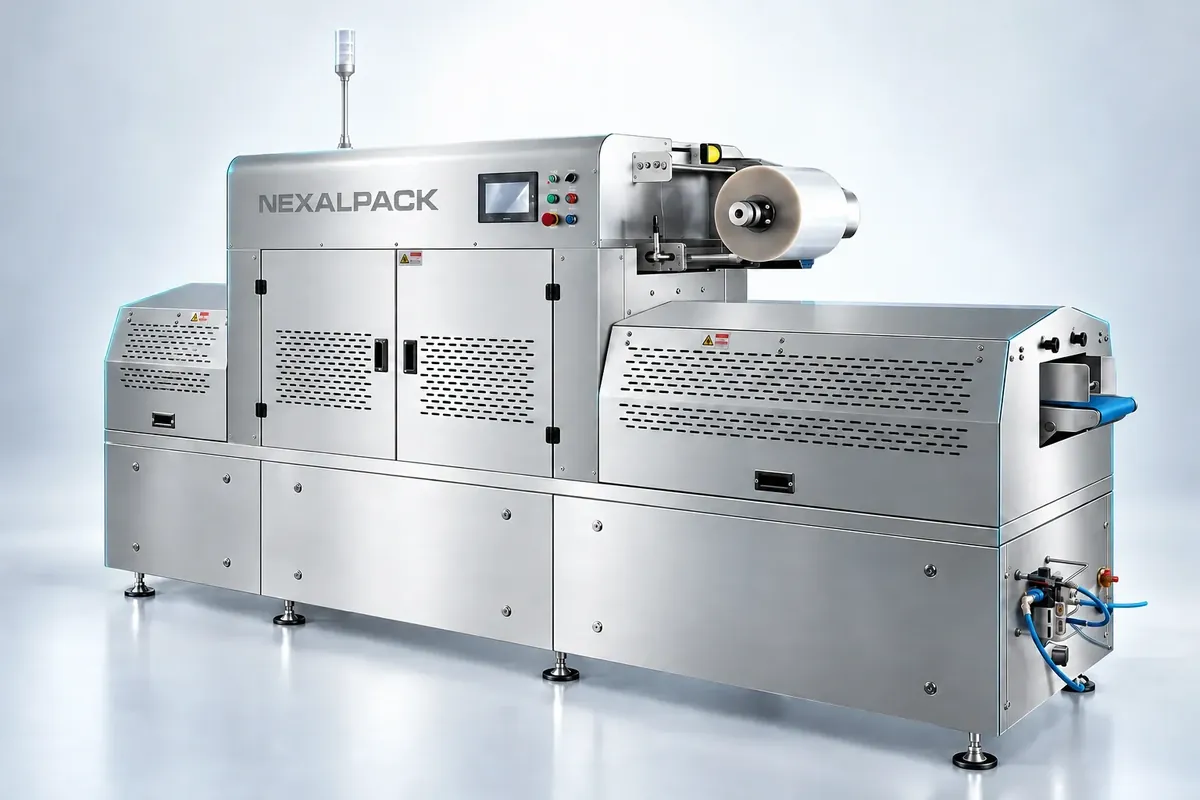
Cycles per minute are not packs per minute: one cycle can seal several trays depending on the mould. Figures are indicative and are confirmed in the quotation.
If you are weighing preformed trays against packs formed in-line, read thermoformer or tray sealer.
Costs that are not in the machine price
On top of the machine, budget for moulds, consumables, gas, installation and maintenance.
- Moulds: one per tray format. If you sell three sizes, you need three moulds.
- Trays and film: they are the cost per pack. Tray and film are chosen together, because the film has to seal onto the tray material (how tray sealing works).
- Gas: for modified atmosphere, N₂ or a mix of N₂ and CO₂, depending on the product.
- Installation: a three-phase supply, compressed air or water cooling on the industrial models.
- Commissioning, training and spare parts: ask what the quotation includes and which wear parts are worth keeping in stock.
How to get comparable tray sealer quotes
To compare offers, send every manufacturer the same data on product, tray, process and output.
- What product you pack and how many days of shelf life you need.
- The tray: material, outside dimensions, height and a photo or sample.
- The process: seal only, gas flush, MAP or skin.
- The output: trays per hour or per shift, and how many different formats.
- The installation available: 220 V or 380 V three-phase, compressed air, space.
- Whether the machine works on its own or in-line with a filler, conveyors or a labeller.
With this data, any manufacturer can tell you which model fits and what the price includes.
Nexalpack, the thermoforming and tray sealing machine brand of YM Packaging Group, publishes the technical data of its 17 tray sealers so you can compare before asking for a quotation.
Frequently asked questions about tray sealer prices
How much does a manual tray sealer cost?
In Spanish catering-equipment shops, manual and semi-automatic tray sealers for catering trays sell for between about €900 and €2,700 excluding VAT (November 2026), and each extra mould costs between €100 and €260. They seal in air, without gas; if you need modified atmosphere or skin, the price goes up.
Why does a modified atmosphere tray sealer cost more?
Because it needs a sealed chamber, gas valves and, to draw a vacuum before flushing the gas, a vacuum pump. On the market, a tabletop tray sealer with vacuum and gas costs between €5,300 and €6,800 excluding VAT, against less than €2,700 for a catering tray sealer without gas.
What costs are there on top of the machine?
The moulds (one per tray format), the trays and film, the gas if you pack in modified atmosphere, the installation (voltage, compressed air or cooling) and maintenance with its spare parts.
Why does an industrial tray sealer have no list price?
Because it is configured for each project: the process (seal, gas, MAP or skin), the vacuum pump, the film width, the moulds, the output and line integration change the final price. That is why it is quoted on the basis of your product and your tray.
Where can I see Nexalpack tray sealer prices?
We publish the technical data of all 17 Nexalpack tray sealer models. The price is confirmed in the quotation, because it depends on the moulds, the process and the installation. Tell us what you want to pack and we will send you a proposal.